
What the industry is asking
What a Machine Operator Took from the Workplace Health & Safety Show
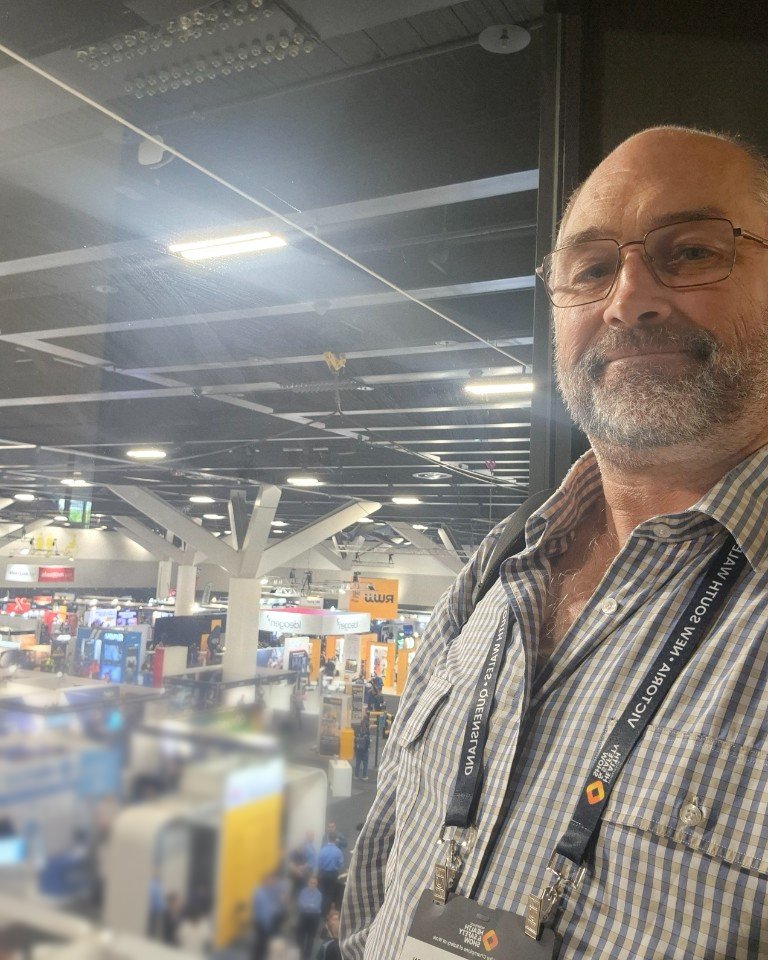
On 21 and 22 October 2026 I spent two days at the Workplace Health & Safety Show at ICC Sydney: over 40 sessions and 200 exhibitors under one roof. I went with one question: what can a small operator-hire business in the Upper Hunter actually use? Here's what I took away.
Built to pass the audit, or built to control risk?
LRQA's session drew a line between safety systems built to pass the audit and ones built to control risk. A completed form proves the paperwork was done. It doesn't prove the control that matters was in place on the day. A system that controls risk starts with leaders and workers knowing the top risks, then checks that the critical controls for those risks are actually working. Under ISO 45001, leaders own those risks and controls, and workers are consulted rather than just told.
What we're doing about it at 1ME: our top risks are clear: underground services, overhead powerlines, people near moving plant, trench edges and fatigue. Prestarts, Take 5s and SWMS sign-ons are done in our operator app, but the point is the controls behind them. Current plans on site, services located and potholed, and an operator who's fit to work.
Safety is led, not filed
Scott Amy from Sentis made the case that the single greatest influence on safety isn't a system, it's a leader. The behaviours he described were simple and hard: respond well to bad news, because how you react to the first problem decides whether you hear about the second. Absorb pressure instead of passing it down. Be predictable. Recognise good work in the moment. Close the loop on everything raised, even when the answer is no. And be in tune with your people, so you notice when someone isn't themselves before the shift starts.
What we're doing about it at 1ME: hazard and incident reports from anyone on a 1ME job come straight to me. A "not fit for work" answer on the prestart sends me an urgent alert so I can act before work starts, and our rostering warns before a shift would break fatigue limits (12 hours a shift, a 10-hour break, 72 hours in 7 days). That makes it easier to push back on a schedule instead of pushing an operator.
Lithium-ion batteries: never bin a battery
Fire and Rescue NSW Commissioner Jeremy Fewtrell spoke about lithium-ion battery fires. FRNSW attended 332 battery-related incidents in 2025, double the 165 in 2022. These fires run hot, give off toxic gas, can reignite and are hard to put out. His two messages were never bin a battery, and charge responsibly.
What it means for us: tool batteries, phones and power banks, often charged in the ute or in accommodation on away jobs. Use the right charger, don't leave batteries charging unattended or overnight, stop using any pack that's swollen, damaged or hot, and take old ones to a battery drop-off, never the site skip. A damaged battery on site can be logged as a hazard in our app. SafeWork NSW's guidance covers charging, storage and what to do in a fire.
Utility strikes
Before You Dig Australia's session was the one closest to our work: more than 15,000 reported utility strikes a year, costing the economy $4.6 billion. I've written it up separately: Utility Strikes: What BYDA Told the WHS Show, and How We Dig.
Fatigue: the new code changes the question
On day two, FatigueTech's session unpacked SafeWork NSW's new Code of Practice: Managing the risk of fatigue at work, which started on 20 February 2026. The shift is from "did we comply with the hours?" to "did we manage the risk?": identify what causes fatigue, assess it, control it and keep checking the controls work. Codes of practice carry weight: a court or an inspector can use one to judge what was reasonably practicable.
The point that stuck with me was the gap between work as planned and work as done. A roster can look safe on paper, then overtime turns a run of 9-hour days into 14 and 16-hour days and the real fatigue risk is several times what was planned. Fatigue also stacks up: a high-risk task, long hours, repetitive or physical work, a long drive home, and not wanting to look like you can't do the job. Each one alone seems manageable. Together they can tip someone over.
What we're doing about it at 1ME: our app already counts the hours actually logged rather than the roster, and starts every day with a fit-for-work check. Since the show, it also warns against the code's higher-risk markers: less than 12 hours between shifts, more than 55 hours in 7 days, more than 5 days in a row and more than 3 night shifts in a row. Those sit alongside our hard limits of 12-hour shifts, 10-hour breaks and 72 hours in 7 days.
AI at work: new duties in NSW
Jennifer Suh, Manager Regulatory Policy at SafeWork NSW, walked through the Work Health and Safety Amendment (Digital Work Systems) Act 2026. A digital work system is any algorithm, AI, automation or online platform used at work: rostering and work allocation software, performance monitoring tools, WHS systems and AI wearables. The law makes clear the duty of care covers these systems, adds a duty to consider the risks when software allocates work (excessive workloads and targets, monitoring and surveillance, and discrimination), and will let union WHS entry permit holders ask for reasonable assistance to inspect a system when they suspect a breach. SafeWork is writing guidelines for that power now; they're expected in 2027, and the power can't start until at least a month after they're published.
Her smart-helmet example made the point well. A helmet that detects bad air and calls for help after a head injury had the room's support. A helmet that tracks location and heart rate all day, until managers start asking about break times and workers stop wearing it, did not. The version that only uses data when there's a hazard, and doesn't keep it afterwards, is the one people trust.
What we're doing about it at 1ME: our operator app rosters shifts and records hours, prestarts and reports, so it's a digital work system under the new law. It was built on the same principle as the trusted helmet: location is only recorded when an operator taps the button on a report, there's no ongoing tracking, fatigue checks use the hours actually worked, and a person in the office makes the final call on any shift that would break a limit.
Mental health: you don't need to be an expert to ask
Medibank's session was about building a workplace where mental health conversations actually happen. The numbers explain why it matters. Safe Work Australia reports mental health claims rose 36.9% between 2017-18 and 2021-22, and the median time off work is more than four times that of a physical injury. Harassment, bullying and work pressure are behind most of them.
The message for leaders was that you don't need to be a clinician. You need to notice, and to ask a plain question like "You don't seem yourself, how are you going?" The steps, adapted from R U OK?, are ask, listen, deal with anything at work that's adding to it, encourage them to get support, and check back in. And it works best built into what already happens, like the prestart or smoko, rather than as a once-a-year event.
What we're doing about it at 1ME: our operator app has a Support page with MATES in Construction, Lifeline, 13YARN and other free, confidential lines. It works without signal and nobody at 1ME is told who called. The daily fit-for-work check asks how you are before the shift starts, and a "not fit" answer comes straight to me so I can call. Most of my days are on other people's sites, so the same plain question applies to the crews I work alongside.
Silica dust: breaking rock is the worst for it
Dr Martin Stirling from Hilti presented new test data on respirable crystalline silica in construction. Silica is in most of what we dig, cut and break: concrete, brick, stone and especially sandstone. It's the fine fraction that does the damage, dust small enough to get deep into the lungs and scar them. Of the four processes tested (drilling, grinding, cutting and breaking), cutting made the most dust by weight, but breaking produced by far the highest share of that fine, respirable dust.
Other points that stuck: wet cutting cuts dust a lot but doesn't eliminate silica, and the slurry has to be collected before it dries and becomes dust again. On-tool extraction captures most of the dust, but what's left in the air can still be enough to matter in an enclosed space, so a second control helps. The limit is 0.05 mg/m³ over an 8-hour shift, and from 1 December 2026 Australia's exposure standards become Workplace Exposure Limits. The limit isn't a safe line, though. The law says to keep exposure as low as reasonably practicable.
What it means for us: SafeWork NSW's silica code of practice lists excavation and earth moving plant, saw cutting and jackhammering concrete as processing silica, and that work must be controlled. A fully enclosed cab with high-efficiency air filtration is one of the recognised controls, so the door stays shut and the filters are maintained. The person most at risk is usually on the ground beside the hammer or the saw: water on the cut or the breaking face, keep clear and upwind, and wear a fitted respirator. Where the work is high risk, the rules since September 2024 also require a silica risk control plan (a SWMS can cover it on construction), approved training, health monitoring and registering workers on the Silica Worker Register.
The takeaway
Across two days, the same idea kept coming back: the paperwork matters less than whether the control works on the day. That goes for services in the ground, fatigue, dust and the person beside you who isn't quite themselves. Thanks to the presenters and the show team for two days that were worth the drive.